Kajian Kes Penyahbuih Rawatan Air Sisa
Foam is essentially a dispersion system where gas is dispersed within a liquid, and its stability depends on three key factors:
1. Surface tension: Cohesive forces between molecules at the liquid surface form an “elastic membrane” that prevents gas escape;
2. Surfactants: Substances like detergents or proteins adsorb at the gas-liquid interface, reducing surface tension and forming a protective layer;
3. Viscosity: High-viscosity liquids delay bubble rupture, making foam more durable.
The Working Principle of Wastewater Treatment Defoamer
Wastewater treatment defoamers disrupt foam stability through synergistic physical and chemical interactions, with their core mechanism simplified into four stages:
1. Penetration: Defomer molecules penetrate the foam surface. Possessing extremely low surface tension, they rapidly diffuse to the gas-liquid interface, displacing surfactants and weakening the foam's “protective film.”
2. Spreading and Displacement: The defoamer disrupts the foam structure by spreading across the surface to form a monolayer. This “pushes away” surfactants from the interface, increasing local surface tension. According to the Marangoni effect, this tension gradient induces fluid flow, causing the foam walls to thin and rupture.
3. Bridging and Coalescence: Wastewater defoamers accelerate the collapse of certain defoamers (e.g., polyethers) by forming “bridging” structures on foam surfaces, connecting adjacent bubbles to promote coalescence and rupture. Others (e.g., mineral oils) sink to the bubble base due to density differences, further destabilizing the foam.
4. Foam Suppression: Wastewater defoamers prevent regenerated defoamers from dispersing into the liquid as microparticles. They continuously adsorb newly formed surfactants, thereby inhibiting secondary foam formation.
Case Studies of Wastewater Treatment Defoamers
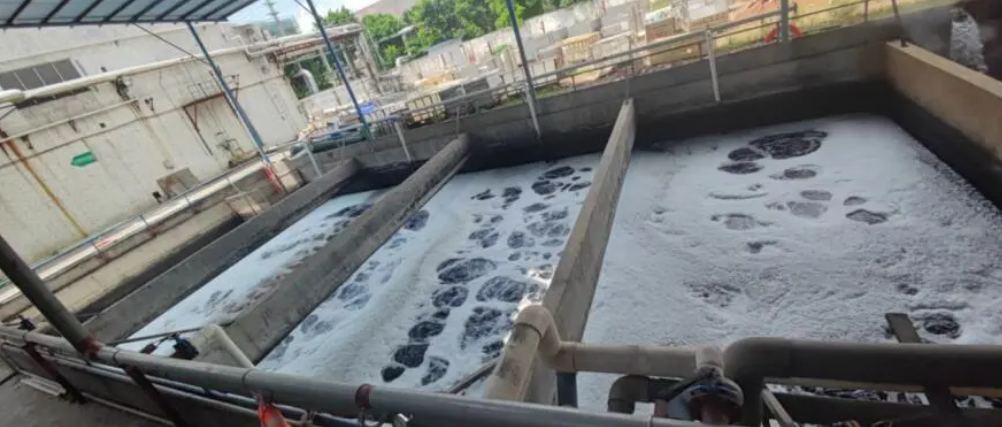
1. Site Overview: A wastewater treatment plant in a Middle Eastern city faced severe foaming issues: excessive foam accumulation in aeration tanks caused equipment clogging and hindered water quality testing. Analysis revealed the primary causes were high detergent (surfactant) content in influent and proteins generated from organic matter decomposition.
2. Solution:
1) Addition of wastewater defoamer: A composite defoamer was selected for its dual capabilities of rapid foam breakdown and long-lasting foam suppression.
2) Application method: Dosage (50-100 ppm) was determined through pilot testing to prevent excessive addition from reducing sludge activity.
3) Synergistic treatment: Combined adjustments to aeration levels and increased carbon source addition optimized the microbial degradation environment.
4) Treatment Effect: Within 30 minutes of application, foam height reduced by 80%; completely dissipated within 2 hours with no recurrence over the subsequent 48 hours, maintaining stable effluent quality compliance.
Minta sampel penyahbuih percuma hari ini!